Shopping cart damage protection is a practical part of retail rack planning, not merely a cosmetic upgrade. Every day, carts turn sharply near endcaps, strike rack legs, or scrape powder-coated surfaces. These small impacts can loosen anchors, expose metal, and create costly maintenance problems.
The key question is how to protect retail display racks from shopping cart damage without restricting customer movement. Retail fixture specialists usually examine cart paths, aisle width, rack height, and vulnerable corners before recommending protection. Paco Underhill, a recognized retail behavior analyst, has often emphasized, “Make it easy for people to shop.” That principle applies here. A protective solution should guide carts naturally, not create another obstacle.
Useful measures include steel kick plates, rounded corner guards, reinforced base frames, and flexible polymer bumpers. A low-profile barrier near the rack base can absorb contact while keeping products accessible. Bright floor markings may also reduce careless turning near crowded displays. However, protection should match the store environment. A warehouse-style guard may look excessive in a premium grocery store.
No barrier is perfect. A poorly positioned guard can redirect a cart into another fixture. That mistake deserves honest review. Store teams should inspect scraped paint, bent brackets, loose anchors, and repeated impact points each week. Photographs can reveal patterns that casual checks miss. Maintenance records also help managers replace weak components before failure occurs.
Effective shopping cart damage protection combines fixture engineering, customer-flow observation, and routine inspection. It protects merchandise, improves rack service life, and supports a safer shopping experience. Small details matter. The strongest plan is practical, visible, and tested against real cart movement.
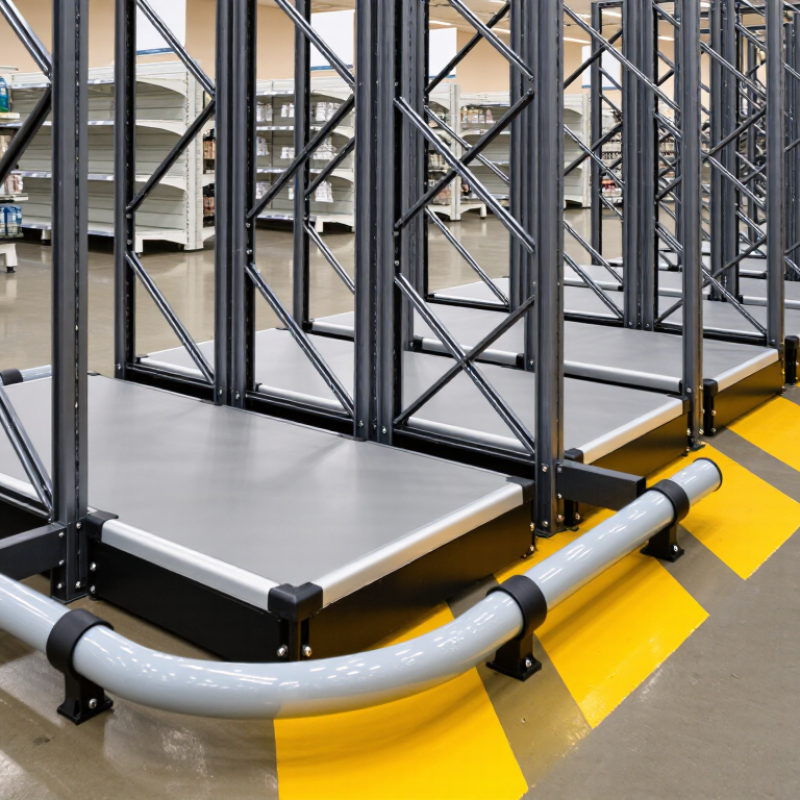
Shopping cart damage protection for retail racks is a physical safety and asset-protection system. It includes rack-end guards, steel barriers, corner protectors, bollards, and impact-resistant panels. These components sit where carts turn sharply, queue, or reverse. Their purpose is simple: absorb or redirect contact before a cart reaches a rack upright, shelf beam, product, or shopper.
The risk is not theoretical. A U.S. Consumer Product Safety Commission report estimated over 20,000 annual emergency treatments for children under five after shopping-cart injuries. The report focused on people, not rack damage, yet it shows how ordinary carts can create serious impact events.
Protection reduces exposed edges, stabilizes vulnerable rack zones, and preserves clear travel paths. It is not insurance. It is engineered separation.
Operational data adds another reason to measure the problem. The 2023 National Retail Security Survey reported an average retail shrink rate of 1.6% in 2022. It valued total shrink at approximately $112.1 billion across surveyed retailers. Shrink is broader than collision damage, so these figures cannot prove cart-related losses. That distinction matters. A practical assessment should record impact marks, bent uprights, repair calls, and blocked aisles. Guard thickness alone is not enough. Placement, anchoring, visibility, and inspection decide whether the system works. One concern remains: a rigid barrier may protect steel while creating a sharper hazard. Good design still needs testing.
Shopping cart damage protection for retail racks begins with understanding how damage occurs. Carts often strike upright frames at aisle ends, especially during busy restocking periods. The impact may leave only chipped paint, yet it can bend the steel behind the surface. Pallet jacks and forklifts create deeper damage near the lower beam levels. Poor visibility, tight turning space, and hurried replenishment make these collisions more likely.
Overloading is another frequent cause. Heavy cartons can deflect beams, while uneven loading concentrates pressure on one section. Missing anchors, loose bolts, uneven floors, and moisture can also reduce rack stability. Customers sometimes pull products from unstable stacks, causing sudden movement. The 2023 National Retail Security Survey reported average retail shrink of 1.6% of sales in 2022, equal to about $112.1 billion. The report does not isolate rack damage, so connecting every loss to damaged racks would be careless. Still, damaged storage can contribute to breakage, product displacement, and unsafe displays. A clean-looking frame can remain weakened.
Tips: Install physical cart guards at exposed corners. Keep aisles wide enough for controlled turns. Train staff to report fresh dents immediately. The Rack Manufacturers Institute recommends documented inspections and prompt evaluation of damaged components. Photograph the impact, unload the affected bay, and restrict access until a qualified person checks it. I have found that visual checks alone miss small twists, so inspection records should include beam levels, anchors, and floor conditions. Review the process after each incident. Some failures come from the system, not one careless employee.
Common causes of damage to retail racks and their estimated share of reported rack-damage incidents.
Shopping cart protection, such as rack-end guards, bollards, and impact barriers, helps reduce damage caused by collisions in retail aisles. Vehicle and cart impacts are commonly associated with rack damage, followed by overloading, incorrect installation, falling merchandise, and moisture-related corrosion. Regular inspections and clearly marked load limits can further improve rack safety.
Data shown as an industry planning benchmark based on commonly recognized warehouse and retail rack damage mechanisms.
Shopping cart damage protection uses physical barriers and planned clearance to keep carts from striking retail racks. Common solutions include steel rack guards, end-of-aisle barriers, wheel stops, and reinforced corner protectors. Each device absorbs or redirects impact before the cart reaches an upright, base plate, or loaded shelf.
The process starts with a site inspection. Staff should observe cart routes, turning points, floor slopes, and crowded promotional areas. Protection must match the impact risk. A low-profile guard may suit a straight aisle, while a wider barrier works better near checkout queues. Anchors keep the barrier stable, but poor placement can reduce aisle space. That weakness deserves attention.
The National Retail Federation’s 2023 National Retail Security Survey reported average retail shrink of 1.6% of sales in 2022. Cart damage is not the only cause, but repeated rack repairs can quietly add to operating losses. The U.S. Bureau of Labor Statistics reported a 2023 retail-trade injury rate of about 3.6 cases per 100 full-time workers. This figure is not cart-specific, yet it supports careful traffic design.
Effective protection also requires routine checks. Look for loose anchors, cracked welds, bent uprights, and missing floor markers. Record the location and frequency of impacts. A guard that repeatedly bends may be undersized, incorrectly positioned, or simply receiving abnormal traffic. Replacement decisions should use inspection records, repair costs, and safety observations rather than appearance alone.
Shopping cart damage protection for retail racks is built around one practical problem: carts turn quickly, stop suddenly, and often strike the lowest rack section. Effective protection begins with a strong base design. Steel or reinforced polymer guards can shield uprights from direct impact. Rounded edges help guide wheels away instead of catching them. End frames should use anchored posts, while wheel stops can limit cart movement near narrow aisles.
Material choice matters. Thick impact rails absorb repeated contact better than thin decorative covers. Replaceable panels are useful because stores can repair one damaged section instead of removing an entire rack.
A small gap between the guard and the shelving can reduce vibration transfer. However, excessive clearance may create a trapped-wheel hazard. That detail is easy to miss during installation.
Protection also depends on layout and maintenance. Wider turning zones, visible aisle corners, and clear floor markings reduce accidental collisions. Rack legs should remain accessible for inspection, not hidden behind permanent covers. Staff can check loose anchors, bent rails, cracked panels, and scraped flooring during routine opening checks. Photographs help track gradual damage.
One weakness remains: no guard can correct poor traffic flow. A heavy barrier may protect the rack but restrict shoppers and cleaning equipment. In some stores, the strongest solution is not the thickest one. It is a balanced system combining flexible protection, sensible spacing, and regular inspection. Designs should be tested with real cart movement, because drawings rarely show every awkward turn.
Shopping cart damage protection shields retail racks from repeated impacts, especially near aisle ends and turning areas. Selection should begin with site measurement, not appearance. Record rack-leg spacing, aisle width, floor condition, and typical cart height. Choose guards that resist bending, absorb contact, and remain visible under store lighting. Rounded edges reduce snagging. A slightly oversized guard may protect better, but it can narrow customer pathways.
Installation quality matters as much as material strength. Position each protector where carts actually strike, rather than where the rack looks vulnerable. Use anchors suited to the floor and follow the rack manufacturer’s structural limits. Keep fasteners flush and check that they do not create trip points. Leave enough clearance for cleaning equipment and emergency access. Poor alignment happens easily.
Maintenance needs a simple inspection routine. Look for loose anchors, cracked surfaces, rust, sharp edges, and shifted guards. Check high-impact corners weekly during busy periods. Replace damaged parts before the rack begins moving. Cleaners can hide small cracks. That is easy to miss. Staff should report unusual impact marks, even when damage seems minor. In practice, no protection system stays perfect; customer traffic changes, aisles move, and earlier measurements may become outdated. Recheck the layout after renovations, new displays, or changes in cart design. Keep inspection records with dates and photographs. This makes recurring weaknesses easier to identify.
| Protection Type | Best Application | Common Material | Typical Size or Coverage | Installation Method | Impact Protection | Maintenance Requirements | Key Selection Consideration |
|---|---|---|---|---|---|---|---|
| Rack Upright Guard | Protecting the lower portion of vertical rack columns from direct cart impacts. | High-visibility polymer, steel, or a polymer-and-steel combination. | Typically 300–600 mm high; selected to cover the usual contact zone of shopping carts. | Floor-anchored, bolted, or mechanically fixed around the upright; maintain clearance from the rack frame. | High | Inspect after impacts, check fasteners, and replace cracked or permanently deformed parts. | Confirm compatibility with upright width, base-plate position, aisle clearance, and floor condition. |
| Rack End Protector | Safeguarding exposed rack ends located at aisle intersections, turning areas, or queue zones. | Heavy-duty molded polymer, steel, or steel with an energy-absorbing outer layer. | Usually extends from floor level to approximately 400–1,200 mm high, depending on traffic exposure. | Anchored to the floor or connected to a dedicated end-frame protection system. | Very high | Keep the area free of debris, inspect anchor points, and verify that the guard has not shifted. | Prioritize the turning radius of carts and the required clear width for customers and accessibility. |
| Low-Level Rack Rail | Creating continuous protection along the front or side of a shelving run. | Powder-coated steel, stainless steel, aluminum, or impact-resistant polymer. | Commonly installed 100–300 mm above the floor and supplied in sections matching the rack bay length. | Bolted to uprights, floor-mounted on brackets, or attached to a reinforced base rail. | Medium to high | Check for loose brackets, corrosion, sharp edges, and damage at joints between sections. | Use when repeated low-height contact is more likely than a concentrated impact on one upright. |
| Flexible Corner or Edge Guard | Covering sharp rack corners, shelf edges, and small contact points near customer walkways. | Closed-cell foam, rubber, thermoplastic elastomer, or flexible PVC. | Often 20–60 mm thick with lengths cut to suit the protected edge. | Adhesive backing, clip-on fitting, or mechanical attachment; surfaces must be clean and dry. | Low to medium | Clean regularly and replace when the material becomes detached, split, compressed, or brittle. | Best for minor contact and injury reduction; it is not a substitute for structural impact barriers. |
| Cart Stop or Wheel Deflector | Reducing cart travel toward rack bases, walls, endcaps, or restricted service areas. | Steel tube, reinforced polymer, rubber, or a mixed-material assembly. | Commonly 75–150 mm high; spacing depends on cart wheel geometry and the protected boundary. | Floor-anchored or fixed to a curb, platform, or purpose-built barrier line. | Medium | Check anchor tightness, alignment, floor damage, and whether wheels can pass underneath. | Allow sufficient approach space so the cart stops gradually rather than striking the device directly. |
| Protective Bollard | High-risk locations such as rack corners beside receiving routes, entrances, or service doors. | Steel pipe or formed steel, usually with a corrosion-resistant coating. | Typical height is 600–1,200 mm, with diameter and wall thickness selected for the expected impact. | Core-drilled, surface-mounted, or chemically anchored to the concrete floor. | Very high | Inspect welds, base plates, anchors, coating damage, and floor cracking around the installation. | Use only where the larger footprint does not create a trip hazard or reduce the required aisle width. |
| Modular Barrier System | Protecting complete rack faces, corners, or high-traffic zones with a continuous solution. | Steel posts, horizontal rails, polymer panels, or combinations of these materials. | Configured by bay length; rail heights commonly range from 300–600 mm above the floor. | Installed as a connected system with anchored posts and replaceable rails or panels. | High to very high | Inspect connections, replace damaged modules, and check that the barrier remains level and stable. | Consider future rack reconfiguration, replacement-part availability, and access for cleaning. |
| Floor-Marking and Visibility Measures | Improving driver awareness and maintaining a defined buffer zone around rack protection. | Industrial floor paint, contrasting tape, reflective markings, or printed warning labels. | Buffer zones should be based on cart size, aisle layout, turning movement, and local safety requirements. | Apply to a clean, dry, properly prepared floor after physical protection has been positioned. | Preventive | Clean the surface and renew markings when they fade, peel, or become difficult to distinguish. | Use as a visual control alongside physical protection, not as the sole method of preventing impact. |
It uses guards, barriers, corner protectors, and impact-resistant panels. These parts separate carts from rack frames, products, and shoppers.
Place it at aisle ends, sharp turns, queue areas, and reversing points. Protect locations where carts actually strike. Measure before buying.
Tight turns, poor visibility, hurried restocking, and crowded aisles increase collision risks. A small dent may hide a bent upright.
No. It reduces impact exposure but cannot replace inspections, clear aisles, or staff training. It is not insurance.
Record aisle width, rack-leg spacing, cart height, floor condition, and cleaning access. A larger guard may protect better but reduce pathway space.
Photograph the damage and unload the affected bay. Restrict access until a qualified person evaluates the rack and its anchors.
Check high-impact corners weekly during busy periods. Look for loose anchors, cracks, rust, sharp edges, and shifted barriers.
Do not rely on appearance alone. Poor alignment happens. Use suitable floor anchors, flush fasteners, emergency clearance, and rounded edges.
Yes. Paint may hide twists, loose bolts, or weakened steel. Visual checks can miss small changes, so records should include photographs and dates.
Shopping cart damage protection for retail racks refers to the barriers, guards, and structural features designed to reduce impact from carts and prevent costly damage to displays, shelves, and stored products. Retail racks are commonly affected by careless turning, overcrowded aisles, sudden stops, and repeated contact with cart corners or wheels. Effective protection helps maintain rack stability, improve store safety, extend equipment life, and preserve an organized shopping environment.
To understand how to protect retail display racks from shopping cart damage, retailers should consider reinforced corner guards, end-of-aisle barriers, protective rails, impact-absorbing materials, and sufficient clearance between traffic paths and rack frames. Selection should be based on rack type, cart size, aisle layout, expected traffic, and the severity of possible impacts. Correct installation is essential, including secure fastening and proper alignment, while routine inspections should check for loose hardware, cracks, deformation, and worn protective components. Prompt repairs and regular maintenance ensure continued protection and reliable performance.

Ciho Racks