Warehouse rack uprights are among the most vulnerable components in a busy distribution center. A single forklift impact can bend steel, dislodge pallets, and interrupt daily operations. In 2026, preventing these incidents requires more than warning signs and occasional reminders. It requires a practical system that combines layout planning, operator training, rack protection, and regular inspections.
This guide explains how to prevent forklifts from hitting warehouse rack uprights through clear, measurable controls. Experienced warehouse teams often begin by reviewing impact records, traffic routes, turning distances, and common congestion points. A narrow aisle, a poorly positioned pallet, or a faded floor line can create serious risk. Physical barriers, reinforced guards, visible markings, speed controls, and correctly adjusted mirrors can reduce exposure. Technology also helps. Proximity sensors, camera systems, and fleet data can reveal repeated near misses before damage occurs.
Training remains essential. Operators should practice slow, controlled turns near rack corners, especially when loads obstruct forward visibility. Supervisors should observe real movements, not rely only on classroom attendance. Small details matter, including damaged pallets, uneven floors, and temporary storage in travel lanes. However, no protection system is perfect. Guards may be missing, sensors may be ignored, and procedures may weaken during peak seasons. That reality deserves attention. Effective prevention depends on routine inspection, honest reporting, and continuous improvement rather than one installation or one training session. When teams learn from every contact and near miss, warehouse safety becomes a daily operating standard, not a temporary project.
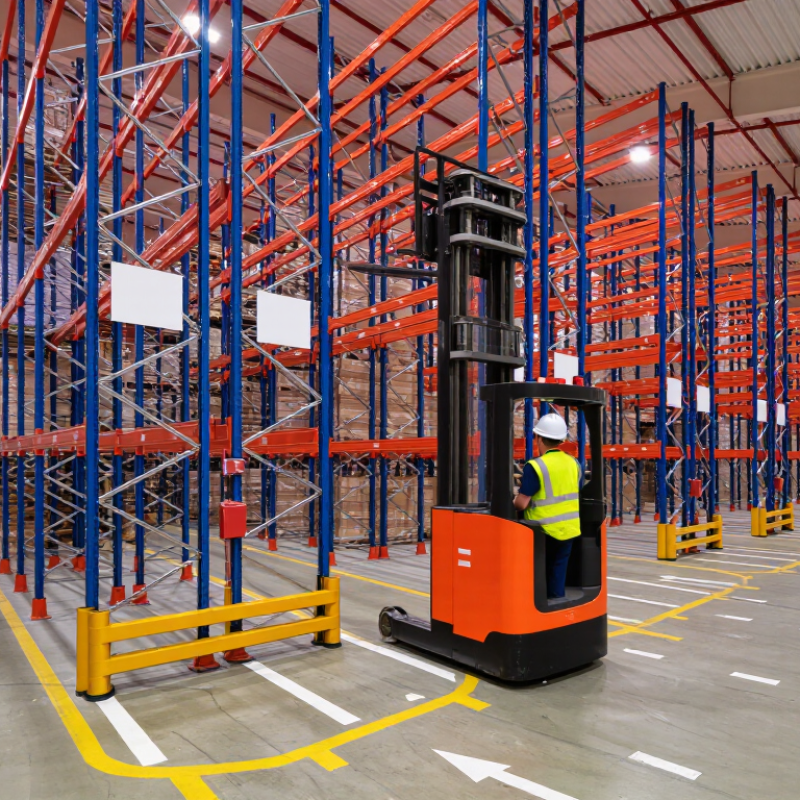
How to Prevent Forklifts Hitting Warehouse Rack Uprights in 2026?
Forklifts usually strike rack uprights because several small failures align. The operator may carry a tall load that blocks forward visibility. A tight turn then brings the rear swing into the upright. Poorly marked aisles, uneven floors, and rushed picking make this worse. Pedestrian traffic can also force sudden steering. Sometimes, the rack layout is the problem, not the driver.
The risk is measurable. OSHA estimates that forklifts cause about 85 workplace fatalities and 34,900 serious injuries annually in the United States (OSHA, Powered Industrial Trucks). The UK Health and Safety Executive reports that workplace transport causes roughly one-quarter of deaths involving vehicles at work (HSE, Workplace Transport Safety). These figures cover more than rack impacts, but they show the exposure clearly.
Walk through the aisle at operating speed. Look for black tire marks, scraped paint, bent guards, and pallets extending beyond beams. Small details matter. Rack guidance from the Rack Manufacturers Institute recommends inspecting damaged components and removing unsafe areas from service. Yet many sites only react after visible deformation appears. That assumption is convenient, and often wrong. Use protected uprights, wider turning zones, speed controls, and one-way traffic where practical. Train operators to stop, lower unstable loads, and reverse when visibility disappears. Review near misses weekly, because a clean incident log may simply mean poor reporting.
Forklift impacts rarely begin at the rack upright. They usually begin with a poor traffic decision. OSHA reports about 85 forklift-related fatalities and 34,900 serious injuries each year in the United States. HSE guidance also states that workplace transport causes around 25% of fatal workplace injuries. These figures make traffic design a control measure, not a decoration.
Start with the map. Mark every rack end, crossing, charging area, staging zone, and blind corner. Measure it again. Aisle width must match the truck, pallet size, turning radius, and operator visibility. A neat drawing can still hide a dangerous reverse turn. During a practical inspection, look for fresh paint damage, bent guards, scraped pallets, and black tire marks near uprights. The damage tells a story.
Separate pedestrians from forklifts where possible, using physical barriers rather than floor lines alone. Keep staging pallets out of turning envelopes. At intersections, improve sight distance before adding warning signs. OSHA’s powered industrial truck guidance emphasizes training, safe operating procedures, and workplace evaluation; layout supports all three. Traffic counts matter too. Record near misses by location and shift, then compare them with congestion periods. One uncomfortable finding may appear: the “quiet” aisle has the highest impact rate because drivers relax there. Review speeds, one-way routes, aisle ownership, and rack protection after every layout change. Human behavior remains difficult to predict. That is why the risk review should never be a one-time exercise.
Preventing forklifts from striking rack uprights starts with clear operating rules and consistent driver behavior. Set a site speed limit based on aisle width, floor condition, and pedestrian traffic. Drivers must complete a pre-shift inspection before moving any load. Check brakes, steering, tires, forks, warning lights, and the backup alarm. Report defects immediately. Do not operate unsafe equipment.
Keep it slow. Drivers should sound the horn at blind corners, aisle crossings, and doorway exits. They must keep both forks low while traveling and maintain a clear view of the route. When a load blocks visibility, travel in reverse or use a trained spotter. Keep a visible buffer from rack uprights, especially when turning with long loads. A few extra seconds can prevent bent steel and falling inventory.
Supervisors should mark travel lanes, pedestrian crossings, and no-entry areas with durable floor signs. Daily briefings should cover recent near misses, damaged uprights, and changing storage conditions. Drivers need practical coaching, not only written instructions. Ask them to demonstrate controlled turning, parking, and load placement during refresher training.
Procedures can still fail. A driver may rush during a busy shift, or a pallet may sit outside its normal position. That is why supervisors should observe real operations and correct unsafe habits immediately. Near misses deserve the same serious review as collisions. Record what happened, inspect the rack, and adjust the rule when the workplace exposes a weakness.
Forklift safety rules should focus on preventing contact with rack uprights: reduce speed in aisles, keep loads stable and low, sound the horn at blind intersections, maintain clear visibility, and require drivers to stop and reassess before turning or reversing near storage locations.
Context data: U.S. OSHA estimates approximately 85 forklift-related fatalities, 34,900 serious injuries, and 61,800 non-serious injuries each year. Actual warehouse results vary by site, equipment, traffic design, training, and enforcement.
Forklift impacts on rack uprights often begin with poor visibility, not reckless driving. Rack protection and visibility improvements should work together.
The U.S. Occupational Safety and Health Administration reports about 85 forklift-related deaths and 34,900 serious injuries annually.
Source: OSHA, Powered Industrial Trucks.
Install upright guards, end-of-aisle barriers, and reinforced corner protection where turning risks are highest. Choose protection that remains visible after repeated impacts. Yellow paint alone is not enough.
A practical warehouse audit should examine sightlines from the driver’s seated position. Check blind corners, cross-aisles, doorways, and low-light storage zones. Convex mirrors can expose approaching traffic. High-visibility rack labels, floor markings, warning lights, and controlled speed zones add useful visual cues.
HSE’s Workplace Transport Safety guidance states that workplace transport causes around 25% of fatal employee injuries in Great Britain.
Visibility deserves engineering attention, not only training.
Keep pedestrian routes physically separated where possible. Place barriers before the first upright, not after damage appears. Inspect anchors, floor fixings, and guard deformation weekly. Photograph defects and assign repair deadlines.
This detail is easy to overlook. A damaged guard can create a new snagging hazard. Protection also needs clearance for pallets and turning radii.
No barrier is perfect. An overconfident layout can still fail during peak shifts. Test the arrangement with loaded trucks, temporary stock, and realistic traffic patterns. Review near misses honestly, even when no rack damage occurs.
How to Prevent Forklifts Hitting Warehouse Rack Uprights in 2026?
Monitoring, Inspecting, and Improving Warehouse Collision Prevention
Forklift collisions rarely begin with a dramatic crash. They often start with a bent guard, a scraped upright, or a driver reversing with limited visibility. OSHA estimates that powered industrial trucks cause about 85 fatalities and 34,900 serious injuries each year in the United States. These figures make collision prevention a management duty, not only a training topic.
Monitoring should combine observation with usable data. Record impact alarms, near misses, damaged pallets, and repeated speeding locations. A simple heat map can reveal danger around dock doors, narrow turns, and busy picking aisles. Review the data weekly. A camera may show the event, but it may not explain why the aisle feels rushed. That needs worker interviews.
Inspect rack uprights at the start of each shift. Look for dents, twists, loose anchors, missing bolts, and displaced beams. After any impact, isolate the bay until a competent person assesses it. The Rack Manufacturers Institute recommends formal rack inspections and documented corrective actions. Do not rely on paint marks alone. They hide small changes.
Improvements should match the actual failure. Install upright guards where contact repeats, improve lighting, separate pedestrians, and mark turning zones clearly. Review forklift speed settings and aisle widths. HSE workplace transport guidance also stresses segregation, visibility, and controlled vehicle routes. Training helps, but training alone is not enough. People still hurry. That is the uncomfortable part. Prevention must be designed into the warehouse, then checked honestly.
| Prevention Dimension | Metric or Inspection Point | 2025 Reference Level | 2026 Control Target | Recommended Frequency | Corrective Action Trigger |
|---|---|---|---|---|---|
| Collision Monitoring | Forklift-to-rack impact events per 100,000 pallet movements | 8.0 or fewer events | Below 4.0 events | Monthly review | Any increase for two consecutive months |
| Impact Detection | Documented impact alerts investigated within one shift | 90% | At least 98% | Every shift and weekly audit | Any alert without a documented review |
| Rack Upright Inspection | Rack uprights and frames inspected for dents, bends, cracks, or missing protection | Monthly | Weekly visual checks plus monthly documented inspection | Each operating area | Any structural deformation or displaced component |
| Damage Classification | Inspection findings classified by severity and assigned an owner | Applied inconsistently | 100% of findings classified and tracked | At every inspection | Unclassified or overdue finding |
| Isolation of Damage | Time from identifying serious damage to isolating the affected bay | Within the same day | Immediately; no continued use before assessment | For every serious finding | Any delay in barricading or unloading the affected location |
| Rack Protection | High-risk uprights fitted with secure, visible impact protection | At least 85% | 100% of exposed end and aisle uprights | Quarterly verification | Missing, loose, or visibly damaged protection |
| Aisle Visibility | Clear sight lines, readable aisle markings, and unobstructed intersections | 90% compliant areas | At least 98% compliant areas | Daily housekeeping check | Any blocked view, faded line, or obstructed crossing |
| Speed Management | Forklift travel speed within site-defined limits in rack aisles | 95% compliance | At least 99% compliance | Weekly trend review | Repeated speeding in one zone or by one operator |
| Operator Training | Operators completing practical training on turning, load stability, and rack clearance | Annual refresher | Initial training, annual refresher, and post-incident coaching | Before authorization and as scheduled | Expired authorization or repeated unsafe maneuver |
| Near-Miss Reporting | Near misses involving tight turns, blocked aisles, unstable loads, or pedestrian interaction | Ad hoc reporting | 100% recorded, reviewed, and assigned an action | Within 24 hours of occurrence | Repeated near miss in the same location |
| Corrective Action Closure | Safety actions completed by their assigned due date | 80% | At least 95% | Weekly action review | Any high-risk action overdue |
| Layout Improvement | Aisle width, turning radius, rack-end clearance, and pedestrian separation reviewed after layout changes | Reviewed when incidents occur | Risk review before every material layout change | Before change and quarterly | New obstruction, traffic pattern, equipment type, or storage configuration |
Several small failures often combine. Tall loads may block forward visibility. Tight turns can bring the rear swing into an upright. Rushed picking, uneven floors, and unclear aisle markings increase the risk.
Yes. Narrow turns, blind corners, and poor cross-aisle design can create predictable contact points. The driver is not always the main problem. Review the layout with a loaded forklift during realistic traffic.
Look for black tire marks, scraped paint, bent guards, loose anchors, and displaced beams. Check for pallets extending beyond rack beams. Small changes matter.
Inspect them at the start of every shift. Complete a formal review regularly and after every impact. Document photographs, locations, and repair deadlines.
Isolate the affected bay immediately. Keep people and equipment away until a competent person assesses it. Do not rely on paint marks to judge structural safety.
Use upright guards, end-of-aisle barriers, and reinforced corner protection. Position barriers before the first upright. Check anchors, floor fixings, and clearance for pallets.
Improve lighting around corners, doorways, and storage zones. Use convex mirrors, bright rack labels, floor markings, and warning lights. Yellow paint alone is not enough.
Separate pedestrian routes with physical barriers where possible. Use one-way traffic and controlled speed zones when suitable. Mark crossing points clearly. Perfect separation may not be practical.
Record near misses, impact alarms, damaged pallets, and speeding locations. Create a simple heat map for busy turns and dock doors. Review findings weekly with operators.
No. Training helps, but warehouse design must support safe decisions. Teach operators to stop, lower unstable loads, and reverse when visibility disappears. People still hurry. That uncomfortable fact needs attention.
Preventing forklift impacts on warehouse rack uprights begins with understanding why collisions occur. Common causes include narrow aisles, poor visibility, confusing traffic patterns, excessive speed, distracted driving, and improperly stored loads. A thorough review of rack placement, aisle width, turning areas, pedestrian routes, lighting, and congestion points can reveal where the greatest risks exist. Based on this assessment, warehouses should establish clear operating rules, including speed limits, designated travel lanes, controlled intersections, safe reversing procedures, load-handling requirements, and regular driver training.
Effective protection also combines physical safeguards with ongoing supervision. Rack guards, end-of-aisle barriers, high-visibility markings, mirrors, warning signs, and improved lighting can help reduce both the likelihood and severity of impacts. To understand how to prevent forklifts from hitting warehouse rack uprights, managers should schedule routine inspections, record every collision or near miss, check for damaged rack components, and correct unsafe conditions promptly. Reviewing incident data and updating procedures regularly creates a safer, more organized, and more efficient warehouse environment.

Ciho Racks