China Top Reach Truck What Is the Ideal Aisle Width?

Time:2026-10-22 Author:Liam
0%

Choosing the correct aisle is central to efficient warehouse planning. Many buyers ask, “what is the ideal aisle width for a reach truck in a warehouse?” The honest answer is not one universal measurement. It depends on the reach truck model, pallet dimensions, rack depth, load height, and operator skill.

David J. Piasecki, a respected warehouse operations author, offers a useful principle: “Aisle width must support the entire handling process, not just the truck.” That advice matters when evaluating a China top reach truck. A narrow aisle may increase storage density, but it can also reduce maneuvering space. A wider aisle may improve safety and speed, yet leave valuable floor area unused.

Measure the truck first.

Typical reach-truck aisles may range from approximately 2.7 to 3.2 meters, but published figures are only starting points. The manufacturer’s turning specification, load length, and required clearance should guide the final layout. A 1,000-millimeter pallet does not behave like a 1,200-millimeter pallet. Floor unevenness, rack protection, and busy pedestrian zones also change the practical answer.

A careful assessment should include a loaded turning test. Mark the proposed aisle with tape. Drive the truck at normal operating speed. Check visibility at the highest lift position. Small errors become expensive during daily operations.

This article examines the key dimensions, operating conditions, and safety considerations behind ideal reach-truck aisle width. The goal is not to promise the narrowest aisle. It is to identify a workable aisle that preserves capacity, control, and dependable performance.
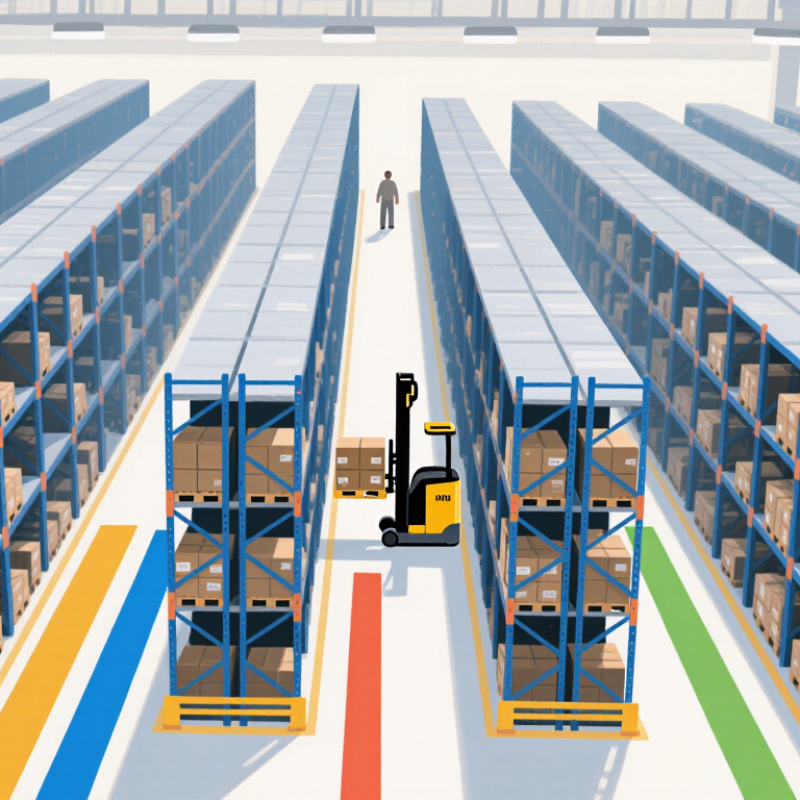
China Top Reach Truck What Is the Ideal Aisle Width?

What Is a Reach Truck and Why Does Aisle Width Matter?

A reach truck is an electric warehouse vehicle designed to place and retrieve pallet loads from high racking. Its reach mechanism allows the forks to extend forward, then retract during travel. This design supports dense storage and reduces the space needed behind the rack. Aisle width matters because every turn, lift, and load movement depends on available clearance. Too little space can cause rack contact, pallet damage, or poor operator visibility.

There is no single ideal aisle width for every reach truck. Many warehouses operate within roughly 2.7 to 3.2 meters, but the correct figure depends on the truck model, pallet dimensions, load overhang, and rack layout. Check the truck’s published turning data. Then test it with the largest real load, not an empty pallet. Small differences matter. A 100-millimeter overhang can change the turning path more than expected.

In practical warehouse planning, measure the working aisle from rack face to rack face. Include pallet deflection, floor unevenness, and space for accurate fork entry. I have seen layouts look efficient on drawings but feel restrictive during live handling. That mistake is easy to make. Operators also need clear sightlines when raising loads. A slightly wider aisle may reduce storage density, yet improve travel control and daily productivity.

The best width is the narrowest space that permits stable, repeatable, and comfortable operation.

How to Determine the Ideal Aisle Width for a Reach Truck

Determining the ideal aisle width starts with the actual reach truck, not a standard chart. Measure the truck with its rated load, mast height, and forks fully positioned. The critical figure is the truck’s Ast value, or aisle stacking width. Use this value as the technical starting point. A 2.7-metre aisle may suit one operation, but fail with deeper pallets or wider loads.

Check the pallet dimensions, rack depth, load overhang, and turning space at each aisle end. Include clearance for steering corrections and uneven floors. Many warehouses allow an extra 100 to 300 millimetres beyond the calculated minimum. That space supports safer travel and reduces rack contact. Operator visibility also matters. A tall load may require more room, even when the truck’s specification appears sufficient.

A taped floor trial can reveal problems quickly. Place sample pallets in the rack and drive the fully loaded truck through the proposed aisle. Watch the rear swing, fork alignment, and turning points. Record the narrowest movement, not the easiest pass. A neat calculation can still fail during busy shifts. I have seen layouts work in an empty test, then feel too tight when pallets were slightly misaligned. Recheck the aisle after installation, especially near corners, rack guards, and emergency access routes.

Which Factors Influence Reach Truck Aisle Requirements?

China Top Reach Truck: What Is the Ideal Aisle Width?

Which Factors Influence Reach Truck Aisle Requirements?

A reach truck aisle is not chosen from a catalogue alone. In practical warehouse planning, 2.7 to 3.2 metres often suits standard pallet handling. However, the exact requirement depends on the truck’s turning geometry, load length, and rack depth. A 1,200-millimetre pallet can need more room when operators enter diagonally.

Mast height also matters. Higher lifts can reduce visibility and increase correction movements. Load overhang, uneven floors, battery position, and steering response create additional clearance needs. The International Labour Organization reports that workplace transport incidents remain a serious safety concern globally. Therefore, saving 100 millimetres may create costly operating risks. A tidy spreadsheet can still mislead.

The MHI 2024 Annual Industry Report identifies labour pressure and operating efficiency as major reasons for adopting automation. Narrower aisles may improve storage density, but only when truck control, rack protection, and operator training support them. ISO 3691-1 also stresses stability, visibility, and safe operating conditions for industrial trucks. Trial movements with the actual pallet are essential. Measure the tightest turn, not the average one. Aisle width should include a practical safety margin, though many layouts understate it. Reviewing real traffic patterns after installation is wise. Warehouses change.

China Top Reach Truck What Is the Ideal Aisle Width? - Which Factors Influence Reach Truck Aisle Requirements?

Influencing Factor Typical Dimension or Range How It Influences Aisle Requirements Practical Planning Guidance
Typical reach truck operating aisle Approximately 2.4–3.0 m
(8–10 ft)
A reach truck generally needs less space than a counterbalance forklift because the load is handled with the mast extended forward and the truck body remains relatively compact. Use the truck manufacturer’s published Ast measurement as the starting point. Confirm the value with the actual pallet, rack, floor, and operating conditions before finalizing the layout.
Narrow-aisle operating target Approximately 2.4–2.6 m
(8–8.5 ft)
This range can support high-density storage when the truck, load, and rack arrangement are specifically designed for narrow-aisle work. Allow additional space if operators have limited visibility, loads are unstable, or pallets must be repositioned frequently in the aisle.
Pallet size and orientation Common footprints include:
1,200 × 800 mm
1,200 × 1,000 mm
1,200 × 1,200 mm
A longer load or a pallet handled with its longer side facing the rack increases the required clearance and turning envelope. Calculate the aisle using the exact pallet footprint and load orientation. Do not design only around an empty pallet dimension.
Load length and overhang Load length may exceed the pallet by
100–300 mm or more
Long or overhanging loads increase the load-center distance and may require more maneuvering room than the standard pallet specification suggests. Include the complete load envelope, including packaging, stretch wrap, irregular items, and any permitted pallet overhang.
Load center distance Often measured at approximately
600–700 mm for common pallet loads
A greater load center can reduce rated capacity and may require slower, wider, or more controlled maneuvers. Check the capacity plate at the actual load center. A truck that can physically enter an aisle may not be rated to handle the planned load at full reach height.
Lift height and rack beam height Common warehouse storage levels:
6–12 m, depending on the facility
Higher lifts can reduce stability and visibility, increasing the need for careful alignment and operational clearance. Verify residual capacity, mast deflection, overhead clearance, and visibility at the highest storage position, not only at floor level.
Truck dimensions and turning geometry Varies by truck configuration;
use the published Ast value
Overall length, wheelbase, steering angle, mast design, fork length, and reach mechanism directly affect the minimum aisle width. Request the truck’s Ast or VDI turning-aisle specification for the exact configuration. A nominal truck class is not sufficient for accurate layout planning.
Fork length and fork positioning Common fork lengths include
1,000–1,200 mm
Longer forks and uneven fork placement can increase the effective load envelope and make pallet entry more difficult. Select fork length according to pallet entry requirements. Keep forks centered and confirm that the fork tips will not contact adjacent loads or rack components.
Rack depth and flue clearance Rack depth commonly matches the pallet system;
clearance must be added
Deep racks and insufficient clearance between loads, uprights, and backstops reduce maneuvering tolerance. Allow clearance for pallet deformation, load variation, rack protection, and safe fork insertion. Use the rack supplier’s required flue and beam clearances.
Floor condition and levelness Smooth, level industrial floor required;
tolerance depends on lift height
Uneven or damaged floors can cause vibration, steering corrections, load movement, and slower travel speeds. Inspect joints, ramps, potholes, and floor flatness before narrowing aisles. High-lift applications generally require tighter floor control.
Pedestrian and vehicle traffic Separate routes are preferred;
width depends on traffic analysis
Shared aisles require additional separation, visibility, and stopping space, which can make a nominal minimum aisle unsuitable. Use physical barriers, marked walkways, warning systems, and site traffic rules. Do not treat a reach-truck minimum aisle as a safe shared-traffic width.
Operator skill and visibility Depends on training, shift pattern,
load visibility, and supervision
Restricted visibility and inexperienced operation increase the risk of rack contact and load damage in narrow aisles. Use trained operators, speed control, mirrors or cameras where appropriate, and a commissioning trial with representative loads.
Fire, emergency, and access requirements Defined by local regulations
and building design
Emergency exits, fire access, sprinkler systems, egress routes, and service access may require wider or unobstructed spaces. Review the warehouse plan with the responsible safety professional and local authority. Equipment maneuverability must not override emergency-access requirements.
Recommended design allowance Add approximately 150–300 mm
where operating conditions are variable
A modest allowance improves tolerance for pallet variation, steering corrections, floor imperfections, and changing operating practices. Treat the calculated minimum as a verification value rather than the final design value. Validate the chosen aisle through a physical or digital maneuvering test.

Planning principle: The ideal reach truck aisle is not a universal number. It should be based on the exact truck configuration, pallet and load dimensions, rack geometry, lift height, floor conditions, traffic pattern, and applicable safety requirements. Always confirm the final aisle width through the truck’s technical data and an on-site operating trial.

How Do China Top Reach Trucks Perform in Narrow Aisles?

China top reach trucks can perform effectively in narrow aisles when the truck, load, and racking are matched carefully. In many warehouses, a working aisle of 2.7 to 3.2 meters is practical, but the ideal width depends on pallet size, lift height, mast design, and turning clearance. Always measure the loaded truck, not only the empty specification sheet.

Good reach trucks use compact chassis designs, precise steering, and stable mast movement. These features help operators place pallets on upper levels without excessive repositioning. In a narrow aisle, even a small steering correction matters. A trained operator should approach slowly, keep the forks level, and confirm pallet alignment before reaching forward. Visibility can still become limited when the mast rises. That is a real operating concern.

Floor quality also affects performance. Uneven concrete can create vibration and reduce confidence during high lifts. Battery condition matters too, especially during long shifts and repeated lifting cycles. A truck may meet its rated capacity, yet feel less stable with a tall or poorly distributed load. This is where specifications need practical review. I would not promise maximum productivity from the narrowest possible aisle. A few extra centimeters may improve safety, turning flow, and daily output. Trial runs with real pallets remain the most reliable way to confirm the right aisle width.

How Can Operators Verify and Maintain Safe Aisle Clearance?

For a reach truck, the ideal aisle width is not a universal number. It depends on the truck model, load size, rack depth, and turning method. Operators should check the equipment data plate and operating manual before setting an aisle width. Measure the truck with its largest planned load, including pallet overhang. The turning envelope matters more than the truck body alone.

Before each shift, inspect the aisle with a tape measure and a loaded test pallet. Check both sides of the truck during a full turn. Leave the clearance required by the manufacturer and the site risk assessment. Do not guess. A painted line is not proof of safety. Floor damage, loose wrapping, misplaced pallets, or bent rack guards can reduce usable space. A trained spotter can confirm blind-side clearance during layout changes.

Keep aisle markings visible and remove obstructions immediately. Inspect rack uprights, floor joints, and impact barriers regularly. Mirrors or cameras may improve visibility, but they cannot replace controlled speed and direct observation. Record measurements after changing pallet sizes, rack positions, or truck attachments. A checklist can create false confidence when conditions change. Even experienced operators may miss a few centimeters near a rack corner. A second person should challenge the measurement, especially in narrow aisles and busy storage areas.

FAQS

What is the best starting point for determining aisle width?

Measure the actual reach truck with its rated load, mast height, and forks positioned for work. Use its Ast value as the technical starting point.

What aisle width commonly suits standard pallet handling?

Many operations use 2.7 to 3.2 metres. The correct width still depends on pallet size, rack depth, load shape, and truck movement.

Why can a 2.7-metre aisle be unsuitable?

Deeper pallets, wider loads, or diagonal entry can require additional space. A narrow aisle may leave little room for steering corrections.

What measurements should warehouse planners check?

Check pallet dimensions, rack depth, load overhang, turning areas, and aisle-end clearance. Include corners, rack guards, and emergency access routes.

How much extra clearance should an aisle include?

Many warehouses add 100 to 300 millimetres beyond the calculated minimum. This space reduces rack contact and supports safer travel.

Does mast height affect the required aisle width?

Yes. A higher mast can reduce visibility and increase correction movements. Tall loads may need more space than specifications suggest.

How can a warehouse test a proposed aisle width?

Tape the proposed aisle on the floor. Drive the fully loaded truck with sample pallets through every important movement.

What should operators observe during a floor trial?

Watch rear swing, fork alignment, turning points, and the tightest movement. Record the narrowest pass, not the easiest one.

Should aisle width be reviewed after installation?

Yes. Recheck busy areas, corners, and emergency routes after installation. Warehouses change, and a perfect calculation can still feel too tight.

Conclusion

A reach truck is designed to lift and place loads at considerable heights while operating in warehouse environments where space is limited. Aisle width directly affects productivity, turning safety, load stability, and the operator’s ability to maneuver without contacting racks or other equipment. The question “what is the ideal aisle width for a reach truck in a warehouse” cannot be answered with one universal measurement. It depends on the truck’s turning radius, overall dimensions, load size, rack layout, lift height, and the direction in which pallets are handled.

To determine a suitable aisle, warehouse planners should review equipment specifications, pallet dimensions, clearance requirements, floor conditions, and traffic patterns. Narrow-aisle reach trucks can improve storage density and maintain precise control, but only when the layout matches their operating capabilities. Operators should verify clearance through measured test runs, marked travel paths, and regular inspections. Keeping aisles free from obstructions, checking rack alignment, maintaining adequate lighting, and following safe operating procedures help preserve clearance and reduce the risk of collisions or load damage.

Liam

Liam

Liam is a dedicated marketing professional with a profound expertise in the industry, where he excels at highlighting the unique advantages of our core products. With a keen understanding of market trends and consumer needs, Liam frequently updates our company’s professional blog, providing......